
Follow the below steps to upgrade the Ambari version.
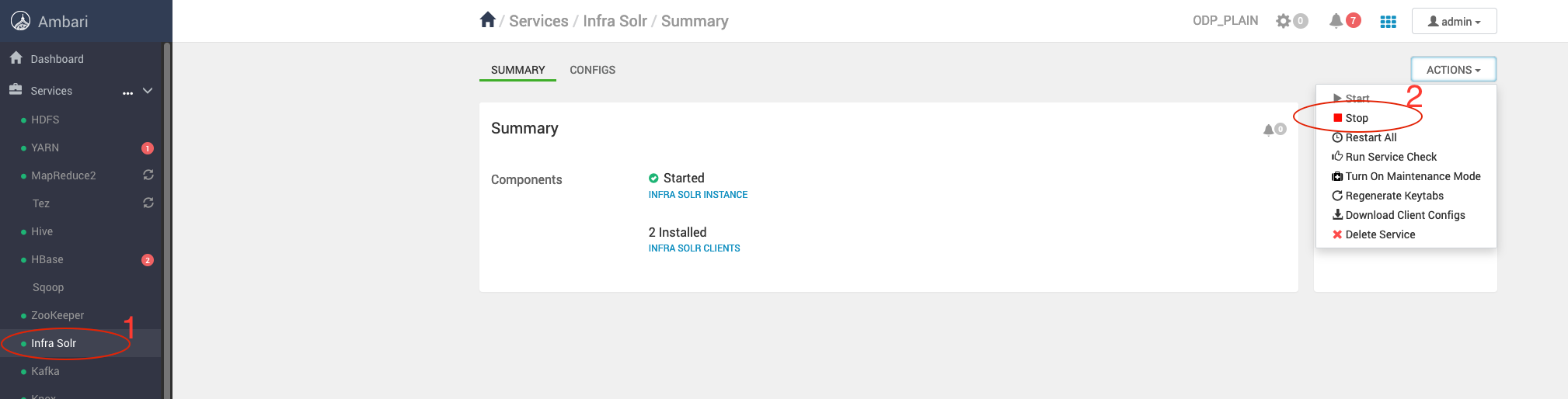
Stop Infra-solr Service
Stop the Infra-solr Service from Ambari-UI.
Stop Ambari Server and Agents
Stop Ambari Server
Take the backup of ambari-server configs.
/etc/ambari-server/conf/
Stop Agents
Stop Ambari-agent on every cluster nodes.
Back up Ambari Database
Take the Ambari-server backend database backup from the server host.
DB Backup Commands
The upgraded version Ambari-2.7.8.2-3 supports only Python 3.11. Ensure that Python 3.11 is installed and configured on all the cluster nodes before proceeding with the upgrade.
Add Ambari Repo on Cluster Nodes
Back up the Old Ambari Repository
Run the following command:
Retrieve the latest Ambari repository details from Accessing Acceldata Repositories and add it to all cluster nodes.
List the existing Ambari packages
On RHEL:
On Ubuntu:
Example Output (if the current Ambari version is 2.7.9.2-1):
Remove existing Ambari rpm’s
From the Ambari Server node, remove the installed packages before upgrading:
On RHEL:
On Ubuntu:
Note
Adjust the package names based on the installed versions on each node.
You can verify the installed packages before removing them using:
On RHEL:
On Ubuntu:
Make sure the Amabri packages are not installed.
Install Ambari packages
If you are upgrading from any Python 2 based ODP version, make sure to perform the below additional steps to install Python 3.11 and its dependencies on all the hosts before proceeding with the next step.
For Ubuntu 20/22:
For RHEL 8:
Install the latest Ambari-server only on ambari-server node.
Server Node
On RHEL:
On Ubuntu:
Ambari Server Configuration Files Restore
Restore the configuration files backed up at step4 (Backup taken in step 4).
Restore ambari.properties File
When prompted, enter 'y' to confirm.
Restore passwd.dat File
Ambari Server Schema Upgrade
Before upgrading, ensure a database backup has been taken (as mentioned in Step 6).
Run the Ambari Server upgrade command:
If you encounter the following error:
Set up the Distro Module
Install the required dependencies on the ambari-server and ambari-agent nodes.
On RHEL:
On Ubuntu:
Retry the Upgrade again
Response when prompted:
After the successful completion, you must see the following message.
Start Ambari-server
Once started, verify that the Ambari UI is accessible using the same URL as before.
Verify Ambari Version
Verify the upgraded Ambari version in admin->about on top right corner in Ambari UI.
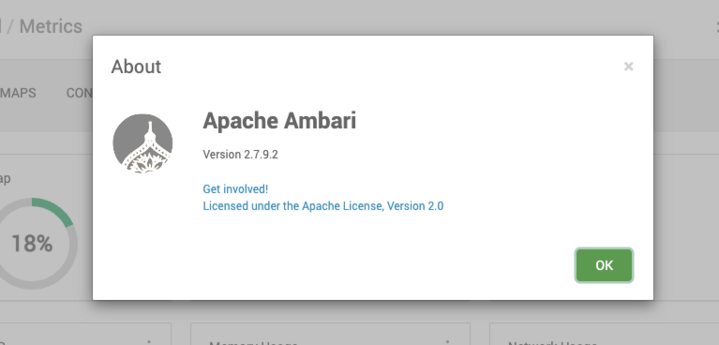
The Ambari version is upgraded successfully.
Upgrade Known Issues
During the migration, the existing GROUPS table in the Ambari database might cause conflicts due to its name. As a result, the Ambari UI might fail to start and throw the following error when attempting to log in.
To resolve this issue, rename the GROUPS table to groups_info in the Ambari backend database.
For MySQL
Log into the MySQL server hosting the Ambari database.
The response is as follows.
Verify the data.
Rename the table
groupstogroups_infousing the following command.
Verify the same data as it was in groups table earlier. It must have the same data as it was earlier in groups table.
For Oracle
Log into the Oracle server hosting the Ambari database.
Verify the existing GROUPS table.
The response is as follows.
Rename the table
groupstogroups_infousing the following command.
The successful rename operation results the output as TABLE Renamed.
Verify the data once renaming is completed.
For Postgres
Log into the Postgres server hosting the Ambari database.
Verify the existing GROUPS table.
The response is as follows.
Rename the table
groupstogroups_infousing the following command.