
Architecture Comparison
The diagram below illustrates the fundamental architectural difference between YARN ESS and Celeborn. ESS scatters shuffle data across all compute nodes and creates M×N network connections. Celeborn consolidates all data for a given partition onto a single worker, reducing connections to M+N.
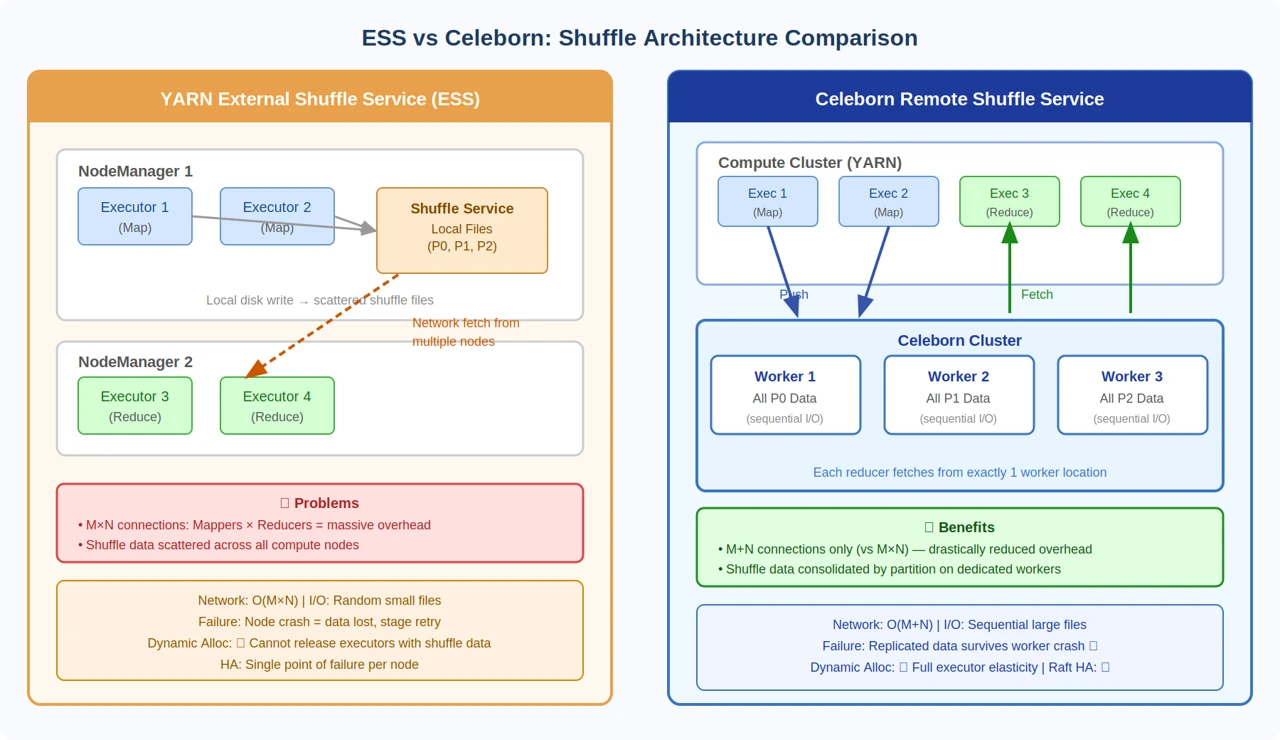
Feature Comparison
Feature | YARN ESS | Celeborn |
|---|---|---|
Architecture | Co-located with compute nodes | Dedicated shuffle cluster |
Data Location | Local disks on compute nodes | Remote shuffle workers |
Network Pattern | M×N (mappers × reducers) | M+N (mappers + reducers) |
I/O Pattern | Random I/O (many small files) | Sequential I/O (consolidated files) |
Replication | None | Configurable (1 or 2 copies) |
Node Failure | Shuffle data lost, stage retries | Data survives, job continues |
Dynamic Allocation | Limited by shuffle locality | Full executor elasticity |
Storage Disaggregation | Not supported | Yes — HDFS, S3 supported |
Multi-Tenant Isolation | No isolation | Quota & worker tags supported |
High Availability | Single point of failure | Raft-based Master HA (3+ nodes) |
Performance Comparison
Metric | YARN ESS | Celeborn | Improvement |
|---|---|---|---|
Shuffle Time | Baseline | 30–50% faster | Network efficiency |
Job Stability | Node failure = stage retry | Node failure = continue | Data replication |
Disk I/O | Random small files | Sequential large files | 2–5× throughput |
Network Connections | O(M×N) | O(M+N) | Drastically reduced |
Memory Pressure | On compute nodes | On dedicated shuffle nodes | Resource isolation |
When to Use Celeborn vs ESS
Scenario | Recommendation |
|---|---|
Small jobs (< 100 GB shuffle) | ESS may be sufficient |
Large jobs (> 100 GB shuffle) | Celeborn recommended |
Dynamic allocation required | Celeborn required |
Cloud / Kubernetes deployment | Celeborn recommended |
Spot / preemptible instances | Celeborn required |
Multi-tenant cluster | Celeborn recommended |
Frequent node failures | Celeborn recommended |
Disaggregated storage needed | Celeborn required |
Single-user development | ESS may be sufficient |
Migration Path
Phase 1 — Pilot
Deploy Celeborn alongside existing ESS
Test with non-critical workloads
Compare performance metrics in parallel
Phase 2 — Gradual Rollout
Enable Celeborn for specific teams or jobs via worker tags
Monitor stability and performance
Phase 3 — Full Migration
Make Celeborn the default shuffle service cluster-wide
Disable ESS on compute nodes
Optimize Celeborn cluster sizing based on observed usage