This page describes how to configure OpenLineage on an Airflow cluster running in GCP Cloud Composer so that DAG execution events are sent to ADOC. Composer is a fully managed service for orchestrating Apache Airflow DAGs, where each Composer environment corresponds to a dedicated Airflow cluster.
Complete the following steps to set up OpenLineage on your Composer environment.
Warning Cloud Composer environments may include OpenLineage by default. Before installing, verify whether OpenLineage is already installed by navigating to Airflow UI → Admin → Providers. If it is present, do not reinstall it, as this may cause dependency conflicts.
In your Composer environment, navigate to the PyPI packages section and add the following package:
apache-airflow-providers-openlineage
You can specify a version, or leave the version field blank to install the latest available version.
In the Airflow Configuration Overrides section, add the following entries:
Section | Key | Value |
|---|
openlineage
| transport
| {"type": "http","url": "<host name of the ADOC tenant>","endpoint": "/torch-pipeline/api/v1/lineage","verify": false, ...}
|
openlineage
| disabled
| False
|
openlineage
| execution_timeout
| 1000
|
openlineage
| debug_mode
| True
|
Note Enabling debug_mode may log and emit extensive details. Use with caution, as it can generate large volumes of data and impact performance.
You can configure one of the following two authentication options.
The simplest option is to provide the ADOC Access Key and Secret Key directly as HTTP headers using the custom_headers configuration. With this option, the Access Key and Secret Key are passed to ADOC through the accessKey and secretKey HTTP headers.
The token-provider implementation and the access_key_secret_token_provider.py file described in 5. Configure Token Provider Plugin (Optional) are not required when using this option.
The transport key in your airflow.cfg should follow this format:
transport={"type": "http","url": "<host name of the ADOC tenant>","endpoint": "/torch-pipeline/api/v1/lineage","verify": false,"custom_headers": {"accessKey": "<access key>","secretKey": "<secret key>"}}
namespace="<openlineage namespace - choose an appropriate name>"
If you prefer not to include your Access Key and Secret Key directly in the transport configuration, you can securely provide these credentials through an Airflow Connection instead.
The base transport configuration:
transport={"type": "http","url": "<host name of the ADOC tenant>","endpoint": "/torch-pipeline/api/v1/lineage", "auth": {"type": "tokenproviders.access_key_secret_token_provider.AccessKeySecretKeyTokenProvider"}}
Follow the steps below to create the Airflow connection to ADOC to provide the access key and secret key:
Log in to the Airflow UI.
Navigate to Admin → Connections.
Click the + (Add) button to create a new connection.
Fill in the following details:
Field | Value / Notes |
|---|
Connection ID | acceldata_connection
|
Connection Type | HTTP
|
Host | <Host name of your ADOC tenant> (use the same host value as defined in the transport configuration)
|
Login | <Your ADOC Access Key>
|
Password | <Your ADOC Secret Key>
|
Click Save to create the connection.
Once saved, Airflow securely manages your credentials, allowing you to omit them from the main transport configuration.
Sample configuration
Section | Field | Value |
|---|
openlineage
| transport
| {"type": "http","url": "https://acceldata.glczyvc.kaasmoz.acceldata.tech", "endpoint": "/torch-pipeline/api/v1/lineage","verify": false, "auth": {"type": "tokenproviders.access_key_secret_token_provider.AccessKeySecretKeyTokenProvider","access_key": "secret_key_value","secret_key": "access_key_value"}}
|
openlineage
| disabled
| False
|
openlineage
| execution_timeout
| 1000
|
openlineage
| debug_mode
| True
|
Note Enabling debug_mode may log and emit extensive details. Use with caution, as it can generate large volumes of data and impact performance.
You can add additional configurations, such as enabling selective DAG processing, by extending the OpenLineage configuration as described in the Using OpenLineage Integration guide. All configurations should follow the standard [section] -> key = value format used in airflow.cfg.
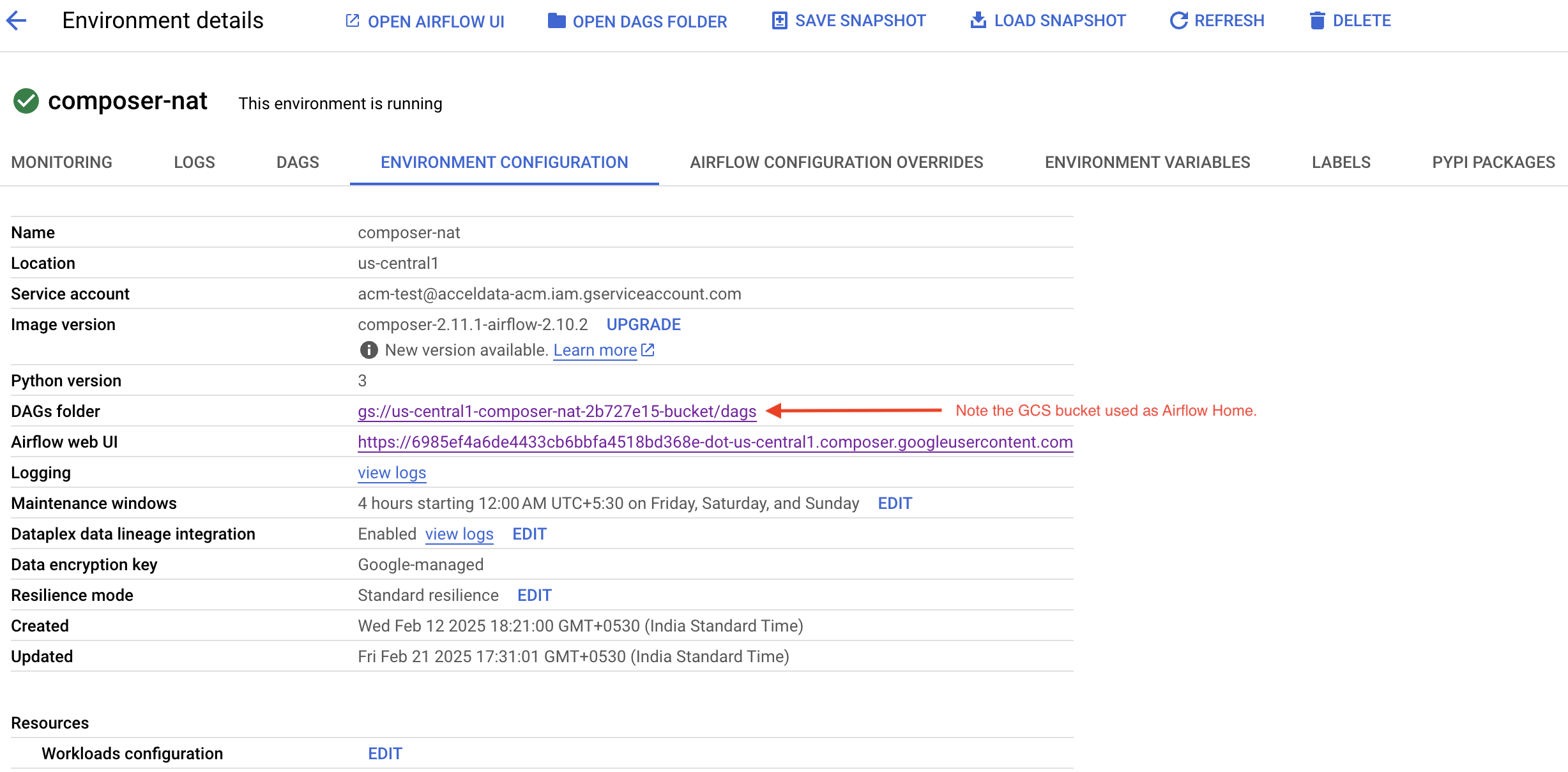
Each Composer instance has a dedicated Google Cloud Storage (GCS) bucket that serves as the Airflow installation directory.
You can find this bucket name in the Environment Configuration section of your Composer instance, under DAGs folder.
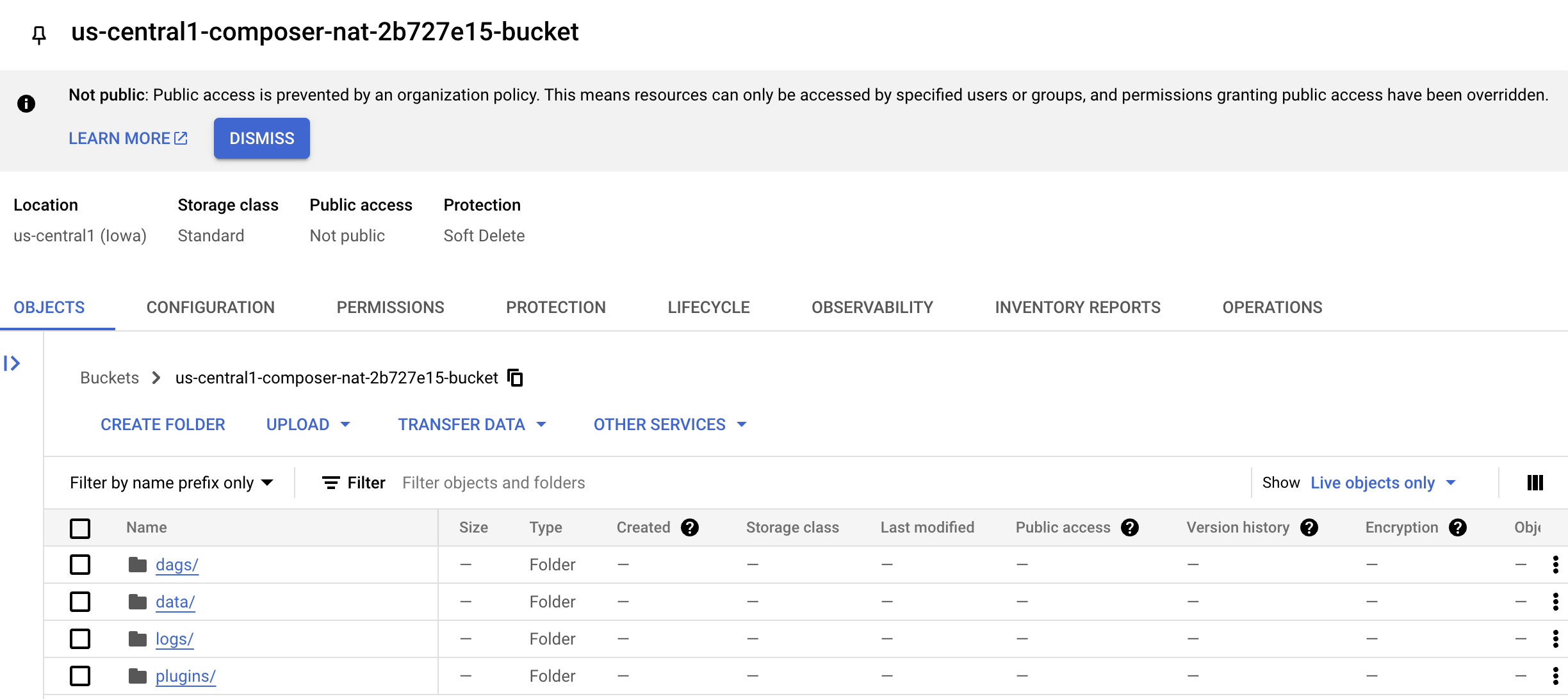
Navigate to the GCS bucket associated with your Composer instance using the Google Cloud Console. Inside the bucket, you will find the dags/, data/, logs/, and plugins/ folders.
This step is not required when using the Custom Headers configuration.
Open the plugins/ folder in the Composer bucket.
Create a folder named tokenproviders.
Upload a file named access_key_secret_token_provider.py to that folder with the following contents:
# Copyright 2018-2023 contributors to the OpenLineage project
# SPDX-License-Identifier: Apache-2.0
from __future__ import annotations
import json
import logging
import os
from datetime import datetime, timedelta
from typing import Any
import requests
from airflow.configuration import conf
from airflow.hooks.base import BaseHook
from airflow.models import Variable
from dateutil import parser
from openlineage.client.transport.http import TokenProvider
log = logging.getLogger(__name__)
# Set the environment variable to bypass proxy
os.environ["no_proxy"] = "*"
CLIENT_ID = "acceldata-app"
TOKEN_PROVIDER_PATH = "/admin/api/onboarding/token-exchange?grant_type=api_keys"
ACCELDATA_LINEAGE_URL = "acceldata_lineage_url"
ACCELDATA_LINEAGE_ENDPOINT = "acceldata_lineage_endpoint"
ACCELDATA_ACCESS_KEY = "acceldata_access_key"
ACCELDATA_SECRET_KEY = "acceldata_secret_key"
ACCELDATA_BEARER_TOKEN = "acceldata_bearer_token"
ACCELDATA_EXPIRES_AT = "acceldata_expires_at"
class AccessKeySecretKeyTokenProvider(TokenProvider):
def __init__(self, config: dict[str, str]) -> None:
super().__init__(config)
log.info(
"Initializing AccessKeySecretKeyTokenProvider. Starting credential resolution."
)
self.access_key = config.get("access_key")
self.secret_key = config.get("secret_key")
if self.is_config_loaded():
log.info("Config is already loaded. Skipping loading from the config.")
else:
ol_config = self._load_openlineage_config()
access_key, secret_key, credential_source, transport = (
self._resolve_credentials(ol_config)
)
if not access_key or not secret_key:
log.error(
"Credential resolution failed. Neither Airflow Connection nor "
"OpenLineage config provides valid access_key and secret_key."
)
return
self._finalize_and_persist(
transport=transport,
access_key=access_key,
secret_key=secret_key,
credential_source=credential_source,
)
def _load_openlineage_config(self) -> dict[str, str]:
config = self.load_config()
return config
def _resolve_credentials(self, config):
transport, access_key_from_config, secret_key_from_config = (
self.extract_transport_and_auth(config)
)
# Try Airflow Connection first
try:
log.info(
"Attempting to load credentials from Airflow Connection: acceldata_connection"
)
conn = BaseHook.get_connection("acceldata_connection")
log.info(
"Airflow Connection loaded successfully (host=%s)", conn.host
)
if conn.login and conn.password:
log.info(
"Using credentials from Airflow Connection "
"(access_key_present=True, secret_key_present=True)"
)
return conn.login, conn.password, "airflow_connection", transport
log.warning(
"Airflow Connection credentials are incomplete "
"(access_key_present=%s, secret_key_present=%s).",
bool(conn.login),
bool(conn.password),
)
except Exception as e:
log.info(
"Airflow Connection 'acceldata_connection' not available. "
"Falling back to OpenLineage config. Details=%s",
e,
)
# Fallback to OpenLineage config
if access_key_from_config and secret_key_from_config:
log.info(
"Using credentials from OpenLineage config after fallback."
)
return access_key_from_config, secret_key_from_config, "openlineage_config", transport
return None, None, None, None
def _finalize_and_persist(
self,
*,
transport,
access_key: str,
secret_key: str,
credential_source: str,
):
self.access_key = access_key
self.secret_key = secret_key
log.info(
"Persisting OpenLineage configuration and resolved credentials "
"(credential_source=%s)",
credential_source,
)
self.persist_config_to_airflow_variables(
transport, self.access_key, self.secret_key
)
# Checking if the acceldata_lineage_backend_url is already available
@staticmethod
def is_config_loaded():
from airflow.models import Variable
log.info(
"Checking OpenLineage configuration state: "
"verifying transport (url, endpoint) and credential availability "
"from Airflow Variables or Airflow Connection"
)
acceldata_lineage_url = Variable.get(ACCELDATA_LINEAGE_URL, None)
acceldata_lineage_endpoint = Variable.get(ACCELDATA_LINEAGE_ENDPOINT, None)
acceldata_secret_key = Variable.get(ACCELDATA_SECRET_KEY, None)
acceldata_access_key = Variable.get(ACCELDATA_ACCESS_KEY, None)
if acceldata_lineage_url is not None and acceldata_lineage_endpoint is not None and acceldata_secret_key is not None and acceldata_access_key is not None:
return True
return False
@staticmethod
def persist_url(transport):
if "url" in transport:
log.info("URL found in the transport")
url = transport["url"]
log.info(
"Persisting OpenLineage backend URL to Airflow Variables (%s)", url
)
Variable.set(ACCELDATA_LINEAGE_URL, url)
else:
log.error(
"Missing required OpenLineage configuration: transport.url not found"
)
@staticmethod
def persist_endpoint(transport):
if "endpoint" in transport:
log.info("endpoint found in the transport")
endpoint = transport["endpoint"]
log.info(
"Persisting OpenLineage endpoint to Airflow Variables (%s)", endpoint
)
Variable.set(ACCELDATA_LINEAGE_ENDPOINT, endpoint)
else:
log.error(
"Missing required OpenLineage configuration: transport.endpoint not found"
)
@staticmethod
def persist_access_key(access_key: str | None):
if not access_key:
log.info(
"access_key not provided for persistence. Skipping Airflow Variable update."
)
return
log.info("Persisting access_key to Airflow Variables")
Variable.set(ACCELDATA_ACCESS_KEY, access_key)
@staticmethod
def persist_secret_key(secret_key: str | None):
if not secret_key:
log.info(
"secret_key not provided for persistence. Skipping Airflow Variable update." )
return
log.info("Persisting secret_key to Airflow Variables")
Variable.set(ACCELDATA_SECRET_KEY, secret_key)
def load_config(self) -> Dict[str, Any]:
log.info(
"Attempting to load [openlineage] section from airflow.cfg"
)
try:
# Accessing the [openlineage] section directly using conf
openlineage_config = conf.getsection('openlineage')
if not isinstance(openlineage_config, dict):
log.error(
"Invalid OpenLineage configuration type. "
"Expected dict but got %s",
type(openlineage_config).__name__,
)
return {}
log.info(
"Successfully loaded OpenLineage configuration: %s",
openlineage_config,
)
return openlineage_config
except Exception as e:
log.error(
"Failed to read [openlineage] configuration from airflow.cfg. Error=%s",
e,
)
return {}
@staticmethod
def get_bearer_token(token):
return f"Bearer {token}"
@staticmethod
def _update_token_to_cache(token: str, expires_in: int):
expiration = datetime.now() + timedelta(seconds=expires_in)
log.info(
"Updating cached bearer token and expiry timestamp in Airflow Variables"
)
Variable.set(ACCELDATA_BEARER_TOKEN, token)
Variable.set(ACCELDATA_EXPIRES_AT, expiration)
log.info("Bearer token cache updated successfully")
@staticmethod
def _get_token_from_cache():
log.info(
"Fetching cached bearer token and expiry timestamp from Airflow Variables"
)
cached_token = Variable.get(ACCELDATA_BEARER_TOKEN, None)
expires_at = Variable.get(ACCELDATA_EXPIRES_AT, None)
return cached_token, expires_at
@staticmethod
def validate_token(cached_token, expires_at):
# Parse the date string into a datetime object
if expires_at is None:
log.warning(
"Bearer token not found in cache. Token will be generated."
)
return False
else:
expires_at_date = parser.parse(expires_at)
if cached_token is not None and expires_at_date > datetime.now():
log.info("Cached bearer token is valid")
return True
else:
log.warning("Cached bearer token has expired")
return False
def _fetch_token_from_admin_central(self) -> tuple[Any, Any] | None:
try:
headers = {
'Content-Type': 'application/json', # Set the content type to JSON
}
access_key = Variable.get(ACCELDATA_ACCESS_KEY, None)
secret_key = Variable.get(ACCELDATA_SECRET_KEY, None)
Variable.get(ACCELDATA_LINEAGE_URL, None)
data = {
'clientId': CLIENT_ID,
'secretKey': secret_key,
'accessKey': access_key
}
token_provider_base_url = Variable.get(ACCELDATA_LINEAGE_URL, None)
if token_provider_base_url is not None:
token_provider_url = token_provider_base_url + TOKEN_PROVIDER_PATH
response = requests.post(token_provider_url, json=data, headers=headers)
log.info(
"Requesting bearer token from Admin Central "
"(url=%s, clientId=%s)",
token_provider_url,
CLIENT_ID,
)
log.info(response)
if response.status_code == 200:
log.info("Bearer token successfully retrieved from Admin Central")
token_data = response.json()
token = token_data.get('access_token')
expires_in = token_data.get('expires_in')
expires_in_sixty_seconds_ago = expires_in - 60
return token, expires_in_sixty_seconds_ago
else:
log.error(
"Failed to fetch bearer token from Admin Central "
"(status_code=%s, response_body=%s)",
response.status_code,
response.text,
)
return None, None
else:
log.warning(
"OpenLineage backend URL (%s) is not configured in Airflow Variables. "
"Token generation cannot proceed without this value.",
ACCELDATA_LINEAGE_URL,
)
except Exception as e:
log.error(
"Exception occurred while fetching bearer token from Admin Central. Error=%s",
e,
)
def refresh_token(self):
log.info("Refreshing bearer token")
token, expires_in = self._fetch_token_from_admin_central()
if token:
self._update_token_to_cache(token, expires_in)
else:
log.error("Bearer token refresh failed")
@staticmethod
def extract_transport_and_auth(config):
"""
Extract transport config along with access_key and secret_key (if present)
from OpenLineage configuration.
Returns:
tuple[dict | None, str | None, str | None]
-> (transport, access_key, secret_key)
"""
if "transport" not in config:
log.error("Missing required OpenLineage configuration: transport")
return None, None, None
try:
transport = json.loads(config.get("transport"))
except Exception as e:
log.error("Failed to parse OpenLineage transport config. Error=%s", e)
return None, None, None
auth = transport.get("auth", {})
access_key = auth.get("access_key")
secret_key = auth.get("secret_key")
if not access_key:
log.info(
"transport.auth.access_key not found in OpenLineage config"
)
if not secret_key:
log.info(
"transport.auth.secret_key not found in OpenLineage config"
)
return transport, access_key, secret_key
# To persist the openlineage configuration to Airflow variables
def persist_config_to_airflow_variables(self, transport, access_key, secret_key):
log.info("Persisting OpenLineage configuration to Airflow Variables")
self.persist_url(transport)
self.persist_endpoint(transport)
self.persist_access_key(access_key)
self.persist_secret_key(secret_key)
def get_bearer(self):
log.info("Checking bearer token in the cache")
cached_token, expires_at = self._get_token_from_cache()
is_valid_token = self.validate_token(cached_token, expires_at)
if is_valid_token:
return self.get_bearer_token(cached_token)
else:
log.info(
"Either the token doesn't exist or has expired. Refreshing token")
self.refresh_token()
cached_token, expires_at = self._get_token_from_cache()
return self.get_bearer_token(cached_token)
This file defines the token provider class referenced in the auth section of the configuration described in Option 2: Airflow Connection with Token Provider.
The Composer environment automatically restarts after you complete steps 1 and 2 to apply the updated configurations.
Once restarted, DAGs in the Composer instance start sending OpenLineage events to the ADOC backend, allowing users to monitor DAG execution.
Once configuration is complete, the DAGs running inside the Composer instance send OpenLineage events to the ADOC backend, enabling users to observe the DAGs.
Warning Ensure the Composer environment has proper network connectivity to the ADOC Control Plane, as this is required for the OpenLineage integration to function correctly.